
Where candlestick analysis comes from
Candlestick Analysis, the study of candlestick charts, originated in Japan when there was no official currency for trading and rice was the true reference in commerce, eventually leading to the creation of the first rice futures market. In the 18th century, a rice merchant named Munehisa Homma began studying the rice market from fundamental to technical aspects. Homma became very wealthy thanks to the price forecasting system he implemented, earning him recognition as the "father of candlestick analysis". With the opening of the Japanese stock exchanges in the late 1870s, candlestick analysis was adopted by Japanese technical analysts.
Why candlesticks instead of bars
Compared to bar charts, candlestick charts give a clearer picture of the ongoing battle between bulls (buyers) and bears (sellers), and, more importantly, clearer trend reversal signals, which is what day traders need most. Forex in particular is a fast market with frequent reversals inside a single session, and forex candlestick trading helps a trader read those turns earlier than a bar chart would. For traders who prefer to work without candlestick patterns at all, see trading a naked chart.
How a candle is built
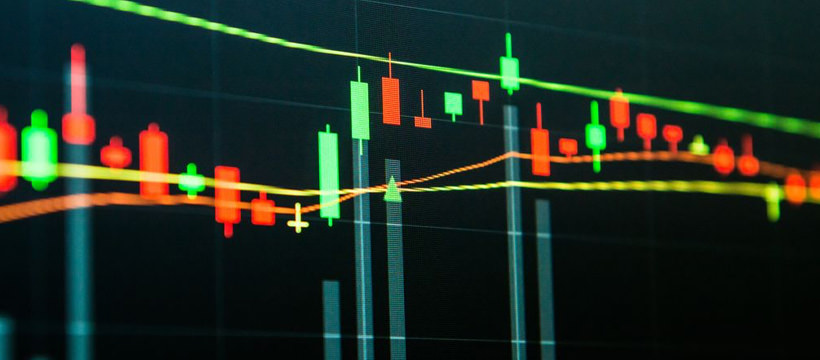
As with bar analysis, constructing a candle on a price chart requires the following elements: open, close, high, low. The characteristic of candles is the real body, a rectangle that connects the opening and closing prices. A bullish candle usually has a white or green real body, while a bearish candle has a black or red body. The real body is simply the price range between the open and close. The vertical lines extending above and below the real body are called shadows: the one above the body is the upper shadow, the one below is the lower shadow.
Starting from this basic information, it is possible to construct a series of candles that can be grouped into two main sections:
- Trend continuation candles
- Trend reversal candles
In general, to obtain actionable signals with candlestick analysis, wider chart patterns are used, i.e., composed of multiple candles (usually three). However, there are also some single candles that have great operational value both as a continuation of the main trend and as a trend reversal.
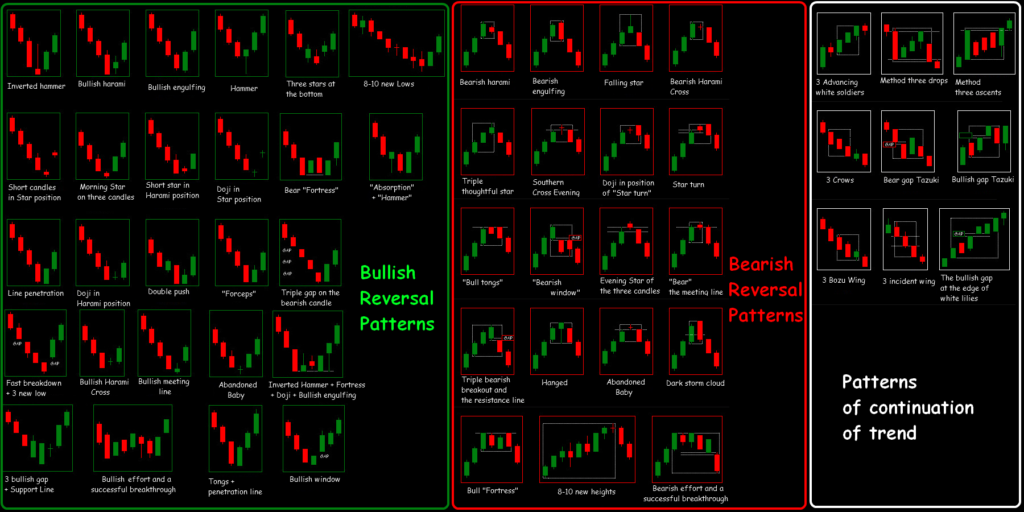
Candlestick analysis patterns
- Doji, Spinning Top, High Wave Candle
- Hammer, Inverted Hammer, Shooting Star, Hanging Man
- Bullish Harami, Bearish Harami, Harami Cross
- Bullish Engulfing, Bearish Engulfing
- Piercing Line, Dark Cloud Cover
- Bullish Counterattack, Bearish Counterattack
- Morning Star, Evening Star
- Tweezer Top, Tweezer Bottom
- Three White Soldiers, Three Black Crows
The patterns this site detects automatically on the Chart Patterns page (engulfing, hammer, shooting star, doji, morning and evening star, three white soldiers and three black crows) all come from this family, and each one carries the historical reliability of its type rather than a guess.