
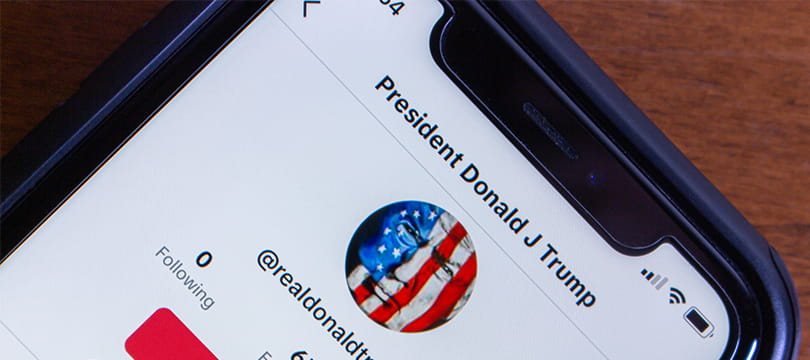
Trump is now a variable that financial markets have to reckon with almost daily. The dynamic is well known and well rehearsed by this point: his statements on tariffs, currencies, central banks or geopolitics have repeatedly triggered sudden — and sometimes very large — market moves.
For anyone trading, that is a problem. Here is how to handle, technically and psychologically, the most peculiar source of volatility of recent years: Donald Trump's announcements.
What Trump's Announcements Do to Markets
Donald Trump has built an important part of his political communication on the ability to surprise. Announcements, threats, previews, interviews and social media posts have come thick and fast for years. The ones that matter most to traders are those that suddenly inject new information on themes markets are highly sensitive to.
Tariffs above all. The possibility of new duties on imports from a country changes expectations about trade flows, inflation and growth, and can therefore move the currencies involved immediately.
August 2026 offered a textbook example, in both directions. Trump had threatened 50% tariffs on Canadian goods, then announced a temporary pause, saying a deal was all but done. On 19 August the Canadian dollar touched its strongest level in about two and a half months against the US dollar, helped by the truce. Within days, though, the script flipped again: talks broke down, the 50% tariffs took effect, and Canada announced dollar-for-dollar retaliation. A single position, long or short, could have been right and wrong several times in a fortnight without the underlying economy changing at all.
Nor is this a new phenomenon. A JPMorgan analysis of more than a hundred of Trump's social media posts found that tariff-related messages were the ones most capable of moving the forex market. In one case, an announcement of tariffs against Canada and Mexico contributed to moves of more than 2% in the Mexican peso and around 1% in the Canadian dollar.
The statements can also hit the dollar directly. In January 2026, Trump's comments brushing aside the greenback's weakness, the dollar was "doing great", he said, added to the pressure on the currency, which fell to its lowest level in four years.
Geopolitics is the other hypersensitive terrain, one explored more broadly in a guide to geopolitical risk in forex. The words of the US president can rapidly change expectations about the probability of a conflict, new sanctions or a diplomatic breakthrough. Oil offers a vivid example: on 17 August 2026, Brent and WTI rose around 2.6% after tensions with Iran escalated and Trump promised to hit back hard. Two weeks earlier, almost exactly the opposite had happened — Trump calling off a planned strike on Iran helped send crude down about 7%.
The point, then, is not whether a statement is politically agreeable. What matters financially is its effect on expectations. The market does not wait for a threat to become law or for a declaration to become an official decision: it often reprices immediately, on the simple fact that a scenario has become more likely.
How to Defend Your Trading Account
You can, however, "defend" yourself from Trump's announcements with a handful of precautions. The first is to treat headline risk, the risk of sudden news, as an integral part of managing every position, a playbook first outlined in an article on political statements and forex risk. In periods of intense trade or geopolitical tension, running the same exposure you would use in normal conditions means accepting far more risk than usual.
Reducing position size is the most direct tool. Smaller positions limit the damage a sudden move can do, and that matters most on instruments directly exposed to US decisions: forex pairs containing the dollar, oil, gold, US equity indices, and the currencies of countries involved in trade negotiations.
Using the stop loss wisely is just as fundamental. During a burst of volatility the price can swing wildly within seconds, while spreads and slippage — the gap between the expected and the executed price — tend to widen. A stop placed too close will be taken out by simple noise, the disordered oscillations the news generates; a dedicated guide covers how to tell whether your stop loss is too tight.
It is also prudent to avoid excessive leverage. An unexpected statement can produce in minutes a move that would normally take hours or days to form. With high leverage, even a relatively contained swing can have an outsized impact on your capital.
Another useful rule is to distinguish the announcement from the decision. A political declaration does not always turn into an actual measure. That is true of every politician, and especially true of Trump: the tariff saga has demonstrated it clearly, with threats, delays, negotiations, agreements and reversals following one another within days. Entering a trade immediately after a headline therefore also means exposing yourself to a denial, or a change of position, a few hours later.
The Psychology: You Do Not Have to Trade Every Headline
From all this follows an important psychological principle: you do not need to participate in every move. When a price rises or falls violently after a statement, it is easy to feel you are missing an unrepeatable opportunity. Chasing the move, however, usually means entering after a large part of the reaction has already happened, one of the reasons news trading is less reliable than it looks.
Better to wait for volatility and spreads to normalize, then assess whether conditions consistent with your strategy still exist. Keeping an eye on the scheduled side of the market helps too: you cannot predict a social media post, but you can know exactly when the next data release or central bank decision is due from the economic calendar, and check how turbulent each pair currently is on the volatility page.
Finally, avoid turning political opinions into financial forecasts. Liking or criticising Trump does not help you predict EUR/USD, oil or the S&P 500. Markets react to the expected economic consequences of his statements, not to anyone's personal judgment of them.
In short: you cannot stop an unexpected announcement from moving the market. What you can do is stop a single move from compromising your capital, or from pushing you into impulsive decisions. Cool blood and technical discipline are enough.