

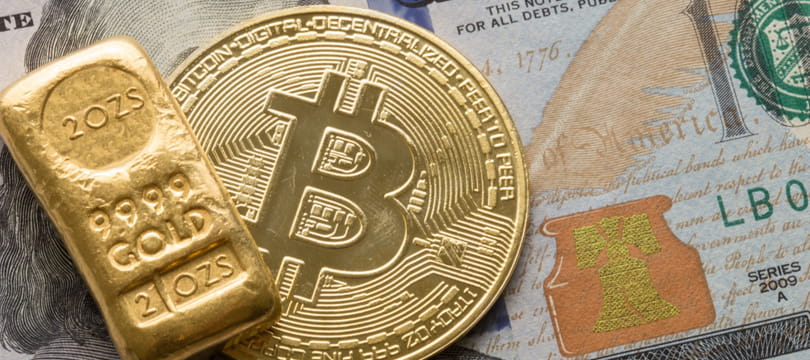
For most of a decade, bitcoin was sold as digital gold: scarce, outside the banking system, a hedge against currency debasement. The comparison was never tested properly, because for most of that decade both assets were rising and nothing forced them apart.
2025 tested it. Gold had one of its strongest years since the 1970s and bitcoin had one of its worst relative years on record, and the two assets behaved in ways that were not similar at all. That divergence is the most useful data point the bitcoin vs gold argument has produced.
What gold did, and why
Gold spent 2025 rising almost continuously, closing the year up 65% at a spot price around $4,310, its strongest year since 1979, when US inflation was above 13%. Inflation in 2025 was nothing like that, which means the driver was something else.
The something else was central banks.
In 2022, the United States and its allies froze roughly $300 billion of Russian foreign exchange reserves overnight. Every reserve manager in the world drew the same conclusion from that: dollar reserves are not neutral assets, they are claims held inside somebody else's legal system, and that system can be turned off.
The response has been a sustained shift into the one reserve asset that carries no counterparty. Central banks have kept buying at levels far above the pre-2022 norm: 863 metric tons in 2025, led by Poland, Kazakhstan and Brazil, even as the pace eased from the record of three years before. This is not speculative retail flow. It is strategic accumulation by institutions that measure their holdings in the hundreds of billions and are not price-sensitive in the way a trader is.
Retail demand added to it: persistent inflation, bank failures still fresh in memory, and continuous geopolitical stress. But the structural bid came from official sector buying, and that matters, because it is the kind of demand that does not reverse on a bad week.
The manner of the rise is as informative as the size. Gold went up steadily, with low realized volatility by any historical standard, and no episode where the market stopped functioning.
What bitcoin did
Bitcoin reached an all-time high above $126,000 in October 2025 amid the loudest possible bullishness, then had one of the most violent deleveraging events in its history.
Over a single weekend it fell from around $124,000 to about $105,000. Ether fell double digits. Smaller tokens lost 40% to 70%, and some effectively went to zero on thinner venues. Estimates of leveraged positions liquidated in that 48-hour window ran to around $19 billion.
The mechanism was not a change in anyone's view of bitcoin. Traders running 20x and 30x leverage had their margin wiped out, forced liquidations generated automatic selling, that selling triggered the next tier of liquidations, and the cascade fed itself. It is the same self-reinforcing structure as any forced-flow event, running downward.
By late November the price had reached the low $80,000s. From the October high that is a drawdown of around 36% in six weeks, and bitcoin finished the year down single digits while gold was up 65%.
For an asset marketed as a safe haven, the timing was the problem. It did not fall because the world was calm. It fell hardest during the period of greatest stress.
The number that settles the argument
There is an objective test for whether something is a safe haven, and it is not the narrative. It is correlation with risk assets.
Over 2025, bitcoin's correlation with the S&P 500 ran strongly positive. When equities fell, bitcoin fell, with more amplitude. It traded as a high-beta technology asset, because that is what the marginal buyer treats it as.
Gold's correlation with equities over the same period was close to zero or slightly negative, which is exactly the behavior a hedge is supposed to have.
Volatility says the same thing from a different angle. Over 2025 bitcoin's realized volatility ran several times gold's. Several times as much movement per unit of time is not a difference of degree; it is a different asset class.
The stress-event record is consistent and goes back further than 2025:
- March 2020, Covid crash. Gold fell about 12% in the initial dash for cash and recovered within weeks. Bitcoin fell roughly 50% in a day.
- February 2022, Ukraine invasion. Gold rose. Bitcoin fell around 20%.
- October 2025. Gold kept rising into its own record. Bitcoin lost a third.
There is one genuine exception. In March 2023, during the failures of Silicon Valley Bank and Credit Suisse, bitcoin rose around 40% while risk assets fell. That episode is worth taking seriously, because it was a crisis of the banking system specifically, and bitcoin's design is a direct answer to that particular risk. It hedges bank failure. It does not hedge risk-off.
Why reserve managers still don't hold it
Central banks have been buying gold in size and hold essentially no bitcoin. That is not a technology gap: China has banned bitcoin trading while accumulating gold aggressively. The one exception proves the point. In November 2025 the Czech National Bank bought a test portfolio worth about $1 million, bitcoin alongside a stablecoin and a tokenized deposit, with a trial allocation of up to 1% discussed afterward, and it said explicitly that none of it counts as official reserves. A central bank willing to experiment still would not call it a reserve asset.
The reason is mandate. A reserve manager cannot hold an asset that can halve in two months. There is no framing in which "we lost 40% of the national reserve, but the long-term thesis is intact" survives a parliamentary hearing. Reserves exist to be available in a crisis, at a value that can be relied on, which rules out anything with 65% volatility regardless of its long-run expected return.
The second reason is universality. Every state on earth will accept gold as settlement. Bitcoin's official acceptance is narrow, and the one country that made it legal tender has since scaled the mandate back under IMF pressure.
None of that means it stays true forever. It does mean that when institutions managing trillions vote with their purchases, the vote is all but unanimous and it is not for bitcoin.
The case for bitcoin that survives all of this
Concluding that bitcoin is not a safe haven is not the same as concluding it is worthless. The bull case is structural and mostly untouched by 2025.
Absolute scarcity. There will be 21 million bitcoin and no mechanism to create more. Gold is genuinely scarce but roughly 3,600 metric tons are mined every year, and a high enough price makes previously uneconomic deposits viable. Bitcoin's supply does not respond to price at all, which is a stronger property than gold has ever had. The halving, every four years, cuts new issuance mechanically; the most recent was April 2024.
A hedge against debasement rather than against volatility. Government debt and deficits in the major economies are at levels that historically resolve through inflation rather than repayment. An asset with a fixed supply and no issuer is a coherent response to that risk. This is a different question from whether it protects you in a bad month.
Institutional access exists now. Spot exchange-traded funds have been available in the US since January 2024, holding tens of billions. Corporate treasuries hold it. Some pension funds have small allocations. Whatever one thinks of the asset, the plumbing question is settled.
Portability. Moving $100 million of physical gold across a border requires vaults, insurance, armored transport and declarations. Moving the same value in bitcoin requires remembering twelve words. For anyone facing capital controls or confiscation, that is not a marginal advantage; it is the entire proposition, and gold cannot match it at any price. The 2022 exodus from Ukraine was the live demonstration: with banks limiting withdrawals and cash impractical to carry, savings crossed the border on phones and hardware wallets.
Two assets, two jobs
The framing as a competition is the mistake. They are not substitutes, and the 2025 data makes that clearer than any argument.
Gold is insurance. Low volatility, negative correlation to equities, universal acceptance, official sector demand. It is not supposed to make you rich. It is supposed to still be worth something on the worst day, and it does that job with a track record measured in millennia rather than years.
Bitcoin is a high-beta bet on monetary technology. Enormous upside, drawdowns of 70% or more within its normal range, correlated to risk appetite and to global liquidity. It behaves like an early-stage growth asset because that is what it is.
Holding both is coherent. Holding bitcoin instead of gold on the grounds that it is digital gold is a position that 2025 falsified in a fairly direct way. Holding gold instead of bitcoin on the grounds that bitcoin is a fad is a different error, made mostly by people who have not looked at the supply schedule.
What to take from it as a trader
Test the label against the correlation. Any asset described as a hedge can be checked in about five minutes: correlate its returns with equities during the drawdowns of the last five years. Narrative is free; the correlation is not.
Leverage is what turns a fall into a collapse. The October 2025 move was not a repricing of bitcoin's fundamentals. It was liquidation cascades in a market where a large share of positioning was 20x or higher. The lesson generalizes: in any market where leverage is concentrated, the size of a move tells you about positioning, not about news.
Correlations move. Bitcoin was uncorrelated to equities in its early years, when it was too small and too separate to matter. It became correlated as institutional money arrived, because the institutions holding it manage it inside the same risk framework as everything else. Diversification that depends on an asset staying obscure stops working when it stops being obscure.
Watch the flows underneath. Gold's move was driven by identifiable, slow, price-insensitive buyers. That is a different kind of support from speculative demand, and it is why the rise was orderly. Knowing who is buying tells you more about how a trend will behave than knowing why they should be.
If you trade gold directly, the mechanics of the spot market are worth understanding on their own terms: XAU/USD does not behave like a currency pair even though it is quoted like one.