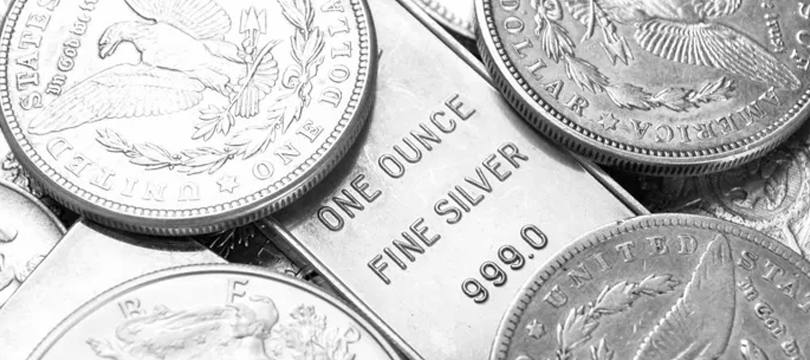

On Thursday 27 March 1980, silver opened around $21.60 an ounce and closed at $10.80. Half the value of a global commodity market disappeared between breakfast and the closing bell.
The cause was three Texan brothers who had spent seven years trying to corner the silver market, had very nearly succeeded, and were now unable to meet their margin calls. The day is remembered as Silver Thursday, and the Hunt brothers silver squeeze remains the most complete case study in market history of what happens when leverage, concentration and a rule change meet in the same week.
Why they wanted silver
The Hunt fortune came from oil. H.L. Hunt, a professional gambler before he was an oilman, built one of America's largest private energy empires and left his children an estate worth billions along with a settled conviction that governments could not be trusted with money.
His son Nelson Bunker Hunt learned that lesson concretely. He had built his own fortune on Libyan oil concessions, and in 1973 Gaddafi nationalized them. Hundreds of millions of dollars vanished by decree. The conclusion Bunker drew was that paper claims (contracts, concessions, government promises) could be erased by a signature. Physical assets could not.
The decade made the argument for him. Nixon closed the gold window in 1971, ending the dollar's convertibility and leaving it backed by nothing but confidence. Then came stagflation: the 1973 oil embargo pushed inflation to double digits, the 1979 Iranian revolution pushed it to 13%, and a dollar held from 1970 to 1980 lost about half its purchasing power.
Gold was the obvious hedge and, until 1974, illegal for American citizens to own: Roosevelt's 1933 prohibition ran for four decades. Silver was legal throughout, cheaper, and had something gold did not: industrial demand. Photographic film consumed enormous quantities, and electronics were consuming more every year. It was money and a raw material at the same time.
How you corner a market
The mechanics are ancient. Buy enough of the deliverable supply that anyone who has sold short must come to you to close, then name your price.
The requirements are demanding: an enormous balance sheet, a market small enough to dominate, the patience to accumulate without being noticed, and regulators who stay out of it. Silver looked feasible. Total above-ground stock outside jewelry and coin was on the order of a few billion ounces, and the freely traded float was a small fraction of that.
The Hunts worked in two phases.
Physical accumulation, 1973 to 1978. They bought bullion (actual bars, not contracts) and moved a large part of it to Switzerland aboard chartered aircraft, outside US jurisdiction and therefore outside the reach of any future confiscation order of the kind that had taken gold in 1933. By 1979 they held around 100 million ounces.
Futures and leverage, 1979 to 1980. Physical silver ties up the full purchase price. A futures contract covers 5,000 ounces and required an initial margin of around 10%, so a dollar of capital controlled ten dollars of metal. The Hunts added futures positions covering roughly 150 million more ounces, some in partnership with Saudi investors.
The combined position was around 250 million ounces. Small against total world silver, but somewhere near a third of the metal actually available to trade, which is the number that matters when someone has to deliver.
Six dollars to fifty
Silver began 1979 near $6 an ounce. By August it was $11. Through September and October it ran to $16 as other speculators recognized what was happening and joined.
By December it was $30, and the effects had reached ordinary households. Americans queued outside dealers to sell inherited flatware, pre-1965 coins and jewelry. Melting old silver became a national activity, which is worth noting: the high price was calling forth exactly the supply that makes a corner impossible to hold.
The peak came on 18 January 1980 at $49.45 an ounce. Silver had risen more than 700% in twelve months. The Hunt position, built at an average cost near $10 to $12, was showing a paper gain measured in billions.
The damage elsewhere was real. Photographic manufacturers faced input costs they could not absorb. Tiffany took out a full-page advertisement in the New York Times condemning what it called unconscionable speculation. Silverware production largely stopped.
The whole precious metals complex moved with it. Gold hit $850 in January 1980, a record that stood for twenty-eight years. Platinum reached $1,000. This matters for the later argument about blame: silver was not rising in isolation.
The exchange changes the rules
The COMEX had a problem, and it was not only that a corner was in progress. Many of its own member firms were short silver (they were the dealers on the other side of the trade), and their losses were mounting toward levels that would have made them insolvent.
On 7 January 1980 the exchange adopted Silver Rule 7. Position limits were imposed at three million ounces per trader, with anyone above required to liquidate. Margin requirements were raised sharply.
The Hunts held around fifty times the new limit.
Two weeks later came the decisive step. On 21 January the exchange moved silver to liquidation only: existing positions could be closed but no new long positions could be opened. The Chicago Board of Trade did the same.
A market in which selling is permitted and buying is forbidden has only one direction available to it. The price began to fall immediately: $44 on 21 January, $34 the day after, then a $31–$38 range through February.
Silver Thursday
Leverage that multiplies gains on the way up demands cash on the way down. As silver fell, brokers issued margin calls, and the Hunts had to produce money within hours or have their positions sold for them.
By March the calls were running into hundreds of millions of dollars. The family was extraordinarily wealthy (oil, real estate, art, racehorses) and almost none of it could be converted to cash in a day. This is the distinction that destroyed them: they were solvent and they were illiquid, and only one of those two things matters when a margin call is due.
On 27 March they failed to meet a call. Word reached the market, brokers began forced liquidation into a book with no bids, and silver fell from $21.60 to $10.80 in a single session.
The wider fear was not about silver. The Hunts owed some $1.7 billion to a long list of brokers and banks, in an economy already carrying 13% inflation and rising unemployment. A disorderly Hunt bankruptcy would have taken several brokerage firms with it.
The rescue nobody called a rescue
Over the following days a consortium of banks, with the Federal Reserve under Paul Volcker closely involved, arranged a loan of about $1.1 billion. The Hunts pledged effectively everything they owned as collateral, agreed to liquidate the silver slowly so as not to break the market again, paid punitive rates, and accepted restrictions on future commodity trading.
It was structured as a commercial loan, so no public money was involved. But the arrangement existed because the authorities decided the failure was too dangerous to allow, the same logic that would be applied to LTCM in 1998 and argued about far more loudly in 2008. Too big to fail was operating in 1980; it simply had not been named yet.
The legal reckoning came later. In 1988 a jury found the Hunts liable for conspiring to manipulate the silver market. A judgment of $134 million went to a Peruvian minerals company, the CFTC added fines of $10 million each, and Nelson Bunker Hunt filed for personal bankruptcy the same year. The family fortune shrank from around $5 billion to a fraction of that as oil prices and Texas real estate collapsed alongside everything else they owned.
Afterward
Nelson Bunker Hunt died in 2014 at 88, having lived his last decades quietly in Dallas. He never accepted the manipulation finding, maintaining to the end that he had bought an asset he believed was cheap in an open market. Asked once how it felt to no longer be rich, he answered that he had known what it was to have a great deal of money and what it was to have very little, and that he had preferred the first.
William Herbert Hunt died in 2024 at 95, well out of public view. Lamar Hunt, the least involved of the three and the first to go (he died in 2006), is remembered for something else entirely: he founded the American Football League, coined the term Super Bowl, and founded the team his family still owns, the Dallas Texans of 1960 that became the Kansas City Chiefs.
The wider family rebuilt substantial wealth over the following decades through other businesses. The silver position was the one bet that nearly ended it.
Were they the villains?
The official account is straightforward: three men attempted to corner a commodity, regulators stopped them, the courts confirmed it. All of that is true.
There is a more uncomfortable version that is also partly true.
Every precious metal roughly tripled or better in 1979 and 1980, driven by inflation running above 13% and a currency that had lost half its value in a decade. The Hunts amplified a move that had causes far larger than them.
The people who wrote the rule that destroyed the position were, in several cases, the people on the other side of it. COMEX members were short, several members of the exchange's board sat at firms carrying those short positions, and Silver Rule 7 converted their losses into gains. That may still have been the right decision for market integrity, but the conflict was not disclosed and not addressed.
And liquidation-only is an extraordinary instrument. It does not restore a market to normal; it guarantees a fall by removing one side of it. Whether an exchange should be able to do that to a specific participant, mid-position, remains a live question.
The reasonable conclusion is that both things happened. The Hunts were reckless and over-levered and were trying to do exactly what they were accused of. The response was also self-interested and unprecedented. Neither observation cancels the other.
What it teaches
Leverage was the whole difference. Had the Hunts bought only physical silver with cash (100 million ounces at $10, sold at $30) they would have made about $2 billion and never faced a margin call. The futures leg is what turned a correct macro view into ruin. Leverage does not improve a thesis; it removes your ability to wait for it.
Illiquid wealth is not collateral. Billions in oil leases and real estate could not settle a call due at close of business. Anyone running leverage needs cash reserves, not net worth.
The rules are not fixed. Exchanges can change margin, impose limits and restrict order types, and they will do so when a position threatens their members. A strategy whose survival depends on the rules staying constant has an unhedgeable risk in it.
Corners are self-defeating. High prices summon supply (in this case out of American kitchen drawers), attract regulatory attention, require ever more capital to maintain, and end in the one act that destroys them: you eventually have to sell.
The 2021 rerun
In January 2021, after the GameStop squeeze, retail forums attempted a coordinated push into silver on the theory that banks were heavily short. Silver moved from around $25 to $30 and then gave it back.
The attempt failed for structural reasons. Silver is a vastly larger and deeper market than a single small-cap equity, retail capital in aggregate is not remotely comparable to what the Hunts deployed, the short position was smaller than assumed, and physical dealers simply widened premiums rather than running out of metal.
The comparison is instructive precisely because it did not work. Cornering a commodity was barely possible for three billionaires with bank financing in 1980. It is not possible for a crowd.
The trade that had everything except an exit
What makes the Hunt story durable is that the analysis was largely right. Inflation was destroying the dollar. Precious metals were the correct hedge. Silver did rise sevenfold.
They lost anyway, because a position that size has no way out. Selling into a market you dominate means selling into the price you created, and the only alternative is holding until someone else decides when you sell. The exchange decided.
Silver finally passed the 1980 nominal high in October 2025 (around $53.8) and ran to roughly $121 in January 2026, but adjusted for inflation the January 1980 peak (around $194 in today's money) still stands, which tells you how extreme the move was. It also tells you that the metal never validated the position while it existed, which is the last lesson, and the one that applies at any account size. Being right about a market is not the same as being able to hold the trade that expresses it.