

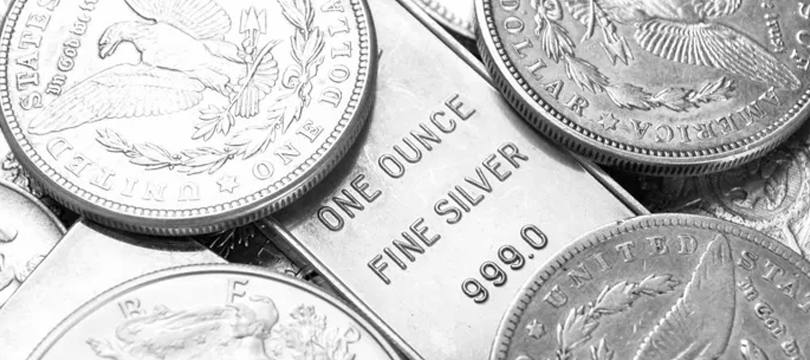
Silver has two jobs and they contradict each other. Half of it or more is consumed by industry (solar panels, semiconductors, electrical contacts, vehicle electronics), which ties it to the manufacturing cycle. The rest is bought as a store of value, which ties it to fear.
In a crisis, one of those buyers wants it and the other stops needing it. In an expansion, the reverse. That split personality is why silver moves further than gold in both directions, and why it is a harder market to hold than either of its two identities suggests.
The industrial half
Silver is the best electrical and thermal conductor of any metal, and the best reflector of visible light. Those are physical properties, not preferences, and they are why it is difficult to design out.
Photovoltaic cells use silver paste for the conductive lines that collect current. Silver appears in semiconductors, in electrical contacts and switches, in brazing alloys, in the growing electronic content of vehicles, and in medical applications for its antimicrobial properties.
Silver industrial demand now accounts for roughly half to sixty percent of the total, and it has been growing, with photovoltaics the single largest source of that growth. Two consequences follow.
The first is that silver has a floor gold does not have. A portion of demand is not discretionary. Manufacturers need physical metal to run production lines, whatever the investment community thinks, which cushions the panic selling that hits purely speculative assets in a downturn.
The second is that silver is exposed to the manufacturing cycle. Weak PMIs, a slowdown in solar installations, or a shift in cell technology that reduces silver loading per panel all reduce real demand. Gold has no equivalent vulnerability.
Substitution deserves an honest note. Where silver can be replaced (copper in some contacts, aluminum in some applications) the alternatives are usually less efficient or need more energy. Substitution therefore happens slowly and only at sustained high prices. Thrifting is the more immediate risk: solar manufacturers have steadily reduced the silver content per cell for years, because it is one of their largest input costs.
The monetary half
Silver was money for most of recorded history, and it retains a role as a store of value. It has one practical advantage over gold: a much lower unit price, which makes physical accumulation accessible to buyers who cannot write a check for an ounce of gold. The old description of it as the poor man's gold is condescending and broadly accurate.
In safe haven episodes silver usually rises alongside gold, and often faster in percentage terms: the market is far smaller, so the same money moves it further.
But the correlation is unreliable exactly when it matters. In the sharpest phase of a crisis, when the demand is for liquidity above all, silver is frequently sold harder than gold. In March 2020 both fell in the initial scramble for cash; silver fell considerably more before recovering more strongly. It is a haven with an industrial beta attached, and the beta does not switch off.
Supply is not a decision anyone makes
The most structurally important fact about silver is that most of it is not mined on purpose.
Roughly three-quarters of mine supply arrives as a by-product of mining copper, lead, zinc and gold. Primary silver mines account for the minority.
The implication is that supply barely responds to the silver price. A copper mine's output is decided by copper economics. If silver doubles, that mine does not produce more silver, because silver is not why it exists. Conversely, if zinc prices collapse and polymetallic mines close, silver supply falls for reasons that have nothing to do with silver.
This is why the silver market has run a structural deficit, with annual demand exceeding mine supply plus recycling, in every year since 2021. That is six years in a row, and above-ground inventories are down by around 762 million ounces over that stretch. Recycling helps but cannot close the gap: a large share of industrial silver is dispersed in small quantities across devices and is uneconomic to recover.
A deficit does not mechanically mean the price rises. Inventories exist and can be drawn down for years. But it does mean the market has less cushion each year, and it explains why silver can spike when a supply disruption coincides with strong demand.
The gold-silver ratio, and what it is worth
The ratio, ounces of silver per ounce of gold, is the most quoted relative value measure in precious metals. It has ranged from the teens to above a hundred over the last century, and it sits near 67 as this is written, in September 2026.
The way it is commonly used is straightforward: a high ratio suggests silver is cheap relative to gold, a low one the reverse, and traders position for reversion.
Two cautions. The ratio has no anchor. The historical 16:1 figure comes from bimetallic monetary systems that stopped existing, and citing it as a target is citing a policy regime rather than a market. And the ratio drifts with the industrial cycle rather than mean-reverting cleanly, because half of one side of the ratio is an industrial input and none of the other side is.
Used as context (is silver rich or cheap against gold right now, and why?) it is genuinely useful. Used as a signal on its own, it is a slow way to be wrong.
Volatility, and the size of the market
Silver's realized volatility typically runs one and a half to two times gold's. That is not a temporary condition; it follows from the market's size.
The silver market is a fraction of gold's in value terms, so a given flow of capital moves it much further. Institutional allocations that are rounding errors in gold are meaningful in silver.
Three things follow for anyone trading it:
- Position size for silver's volatility, not gold's. The same notional exposure carries roughly double the risk.
- Round numbers matter more than usual. Thin markets respect psychological levels, and breaks through them can accelerate as short positions cover.
- The market has been squeezed before. The 1980 attempt to corner it remains the reference case for what happens when concentrated positioning meets an exchange that changes the rules. It is worth reading in full if you trade the metal, because the mechanics have not changed.
What to actually watch
Manufacturing PMIs, particularly from China and the euro area, for the industrial half of demand.
Solar installation data and cell technology news. Photovoltaics are the largest growth component of industrial demand, and changes in silver loading per cell alter the whole demand curve.
Real interest rates. Silver, like gold, pays no yield, so it competes directly with inflation-adjusted bond returns. Rising real rates are a headwind for the monetary half.
The dollar. Priced in dollars, so a stronger dollar is mechanically a headwind.
Inventory and by-product supply. Exchange warehouse stocks, and the health of the copper, zinc and lead mining sectors that produce most of the metal as a sideline.
Two markets in one instrument
Silver is a genuinely awkward asset, and the awkwardness is the opportunity. It is not a leveraged version of gold, though it is frequently traded as one, and it is not a pure industrial metal either.
The clearest way to think about it: gold is a monetary asset with a small industrial component; silver is an industrial metal with a large monetary component. That ordering explains why silver outperforms gold in reflationary recoveries, when both haven demand and industrial demand are rising, and why it underperforms in a pure risk-off event, when only one of them is.
Getting a silver trade right means knowing which of the two markets is currently in charge. Most of the time the price is telling you, and the mistake is assuming it must be the same one as last quarter.