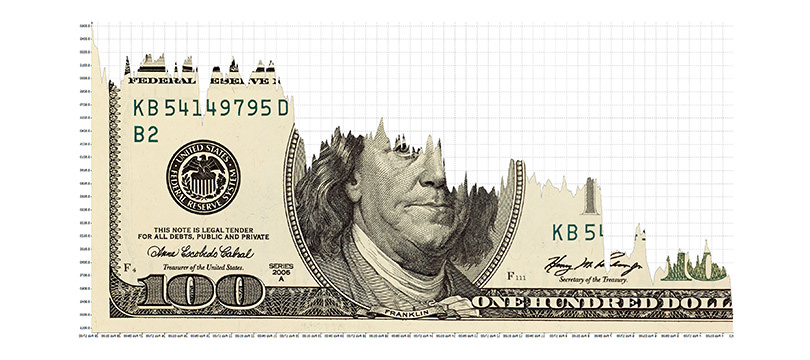


Falling prices sound like good news. Your salary buys more, the weekly shop costs less, and the thing you were saving for gets cheaper while you save for it.
Every central bank in the developed world treats that prospect as a serious threat, and spends considerable effort making sure it does not happen. The reason is that what is pleasant for one household at one moment is destructive for an economy as a whole, and once it starts it is extremely difficult to stop.
What deflation is, and what it is not
Deflation is a sustained, generalized fall in the price level. A common convention requires the consumer price index to be negative year on year for at least two consecutive quarters; there is no formal threshold, and the key word is sustained.
Three things are frequently confused with it:
- A single negative month is noise, usually energy prices.
- Disinflation is inflation slowing down while remaining positive: 5% falling to 2%. Prices are still rising, just more slowly, and this is what central banks are usually trying to achieve.
- Falling prices in one sector, electronics or air travel, is relative price change rather than deflation. Deflation is general.
Why the intuition is wrong
The reasoning that makes deflation look attractive is individual: prices fall, a paycheck buys more, the household is better off. That is true for one person on one day, holding everything else constant.
Nothing else stays constant. In an economy, one person's spending is another person's income, and a general fall in prices means a general fall in revenues, then in wages, then in the spending that produced the revenues.
The spiral
The dangerous part is that deflation is self-reinforcing: once the deflation spiral starts, every step feeds the next.
Prices fall. Consumers notice, and rationally postpone purchases: why buy today what will be cheaper next quarter? Demand weakens. Firms respond by cutting output and staff. Unemployment rises and wages are cut. Household income falls, so demand falls again. Prices fall further.
Each step is a sensible individual response and the aggregate is a contraction. This is the same structure as a bank run: rational behavior producing collective disaster.
Debt is what makes it dangerous rather than merely unpleasant. Debt is fixed in nominal terms. If prices and wages fall 10%, the loan does not fall 10%: the real burden of every mortgage, corporate bond and government bond rises by that amount without anyone borrowing more.
Irving Fisher described this as debt deflation in the 1930s. Borrowers cut spending to service debt they can no longer afford in real terms, which weakens demand, which lowers prices, which raises the real debt burden again. Defaults rise, banks take losses and reduce lending, and credit contracts exactly when it is most needed.
Why the central bank cannot simply fix it
Against inflation, a central bank has an unlimited tool: it can raise rates as far as necessary, and eventually demand breaks. It is painful and it works.
Against deflation, the tool runs out. Rates can be cut to zero and no further in any straightforward way, the zero lower bound. Below zero, savers can hold physical cash instead, which caps how negative rates can usefully go.
Worse, the real interest rate goes the wrong way on its own. If nominal rates are zero and prices are falling 2%, the real rate is positive 2%. Monetary policy is tightening automatically at the moment it needs to loosen, and the central bank cannot stop it.
This is why deflationary episodes produce the unconventional toolkit: quantitative easing, negative deposit rates, yield curve control, forward guidance. All of them are attempts to generate stimulus after the normal instrument has been exhausted, and none is as reliable as simply cutting rates.
Japan: the case everyone cites
Japan is the reference case because the episode lasted long enough to see everything play out.
Between 1995 and 2020, Japanese consumer prices rose about 5% in total — roughly 0.2% a year across a quarter of a century, with frequent negative stretches. Over the same period American prices rose by about 70%.
The trigger was the collapse of an enormous asset bubble in property and equities at the start of the 1990s. Households and companies that had borrowed against inflated collateral spent the following decades repairing balance sheets rather than spending, and the response became embedded in expectations: prices were not expected to rise, so nobody behaved as though they would.
The policy response was everything in the manual. Zero rates from the late 1990s. Quantitative easing pioneered before anyone else tried it. Negative rates. Yield curve control. Fiscal stimulus that lifted government debt to among the highest ratios in the world.
The scale is easy to underestimate. The Nikkei 225 peaked near 39,000 in December 1989, bottomed around 7,000 in 2009, an 82% fall, and did not regain the 1989 high until 2024, thirty-four years later. Japan's nominal GDP in dollars was about $5.5 trillion in 1995 and about $5 trillion in 2020, while America's went from $7.6 trillion to $21 trillion over the same years. The Bank of Japan ended up buying not only bonds but equities, through exchange-traded funds, and became the largest single holder of Japanese stocks. Japan's case also has a layer the price indexes do not show: an aging and shrinking workforce that pushes household saving up and demand down, the mechanism traced in how demographics are reshaping markets.
It took roughly three decades and a global inflation shock to break the pattern. That is the argument for treating deflation seriously: the exit cost is measured in decades, not quarters.
The episode also had a currency consequence that traders live with. Persistent near-zero Japanese rates made the yen the world's funding currency, and an entire class of carry trades was built on it, a structure now being unwound as Japanese yields normalize, which is itself the clearest evidence of how long the exit takes. Deflation in one country became a structural feature of foreign exchange everywhere.
Why the target is 2%, not zero
If price stability is the goal, zero inflation looks like the obvious target. Almost every central bank targets 2% instead, for three specific reasons.
A buffer. With a 2% target, a normal recession pushes inflation to zero or slightly below. With a zero target, the same shock pushes it to −2%, and the spiral starts. The 2% is deliberate space between normal conditions and the danger zone.
Room to cut. Nominal rates are roughly the real rate plus expected inflation. Targeting 2% means nominal rates sit around 2% higher in normal times, which is 200 basis points of cutting capacity available before hitting zero. A zero target throws that away.
Wages do not fall easily. This is the underrated reason. Nominal wage cuts are extremely difficult — employees resist them, contracts prevent them, and morale collapses. With 2% inflation, a firm that needs to reduce real labor costs can simply hold wages flat. With zero inflation, it has to cut pay or cut staff, and it usually cuts staff. Mild inflation is the grease that lets relative wages adjust without unemployment.
Expectations do most of the work
The most important lesson from the Japanese experience is that expectations matter more than current data.
If households and firms expect prices to fall, they act accordingly (postponing purchases, delaying investment, refusing to raise prices) and that behavior produces the deflation they expected. It is self-fulfilling in both directions, which is why central banks talk so much about anchoring expectations.
It also explains why deflation is so hard to reverse. Once people stop expecting inflation, the central bank has to change beliefs rather than prices, and there is no instrument that does that directly. Japanese policymakers eventually resorted to explicitly promising to overshoot their target, to "credibly promise to be irresponsible" in Paul Krugman's phrase from his 1998 paper on Japan's liquidity trap, because a credible promise of future inflation was the only lever left.
The exception: good deflation
Not all falling prices are the same, and the distinction is about the cause.
Bad deflation comes from collapsing demand. Nobody is buying, so prices fall, and the spiral follows.
Good deflation comes from expanding supply or improving productivity. Technology is the standing example: electronics and computing have fallen in price for decades while the sector grew, employed more people and generated enormous value. Prices fell because production got cheaper, not because demand disappeared.
The test is what is happening to output. Falling prices with rising volumes is progress. Falling prices with falling volumes is a contraction.
This distinction matters when reading a headline inflation number: a print pushed down by falling energy prices in a growing economy is a very different signal from the same print produced by weak demand.
Why traders should care
Deflation risk changes the entire policy reaction function, and the policy reaction function is what moves currencies and bonds.
Rates go to zero and stay there, which removes the yield differential that normally drives a currency and turns it into a funding currency instead.
Government bonds perform. A fixed nominal coupon becomes more valuable in real terms as prices fall, which is why Japanese government bonds delivered decent real returns at yields that looked absurd.
Equities struggle, because falling prices compress nominal revenue growth while fixed costs and debt service do not fall with them.
The central bank's asymmetry becomes tradeable. A bank facing deflation risk will tolerate an inflation overshoot for far longer than one facing an inflation problem will tolerate an undershoot. That asymmetry is why a soft inflation print in a low-inflation economy can move markets more than a hot one.
The scenario worth fearing
Deflation is worse than most inflationary scenarios for one reason: inflation can be stopped by a central bank willing to accept a recession, and deflation cannot be stopped by any comparable act of will.
Once the spiral starts, conventional policy is exhausted, real rates rise on their own, debt burdens grow without anyone borrowing, and expectations become self-confirming. The Japanese exit took thirty years and required an external shock.
That asymmetry is the whole reason the target is 2% rather than zero, and the reason central bankers who sound relaxed about a low inflation print usually are not.