
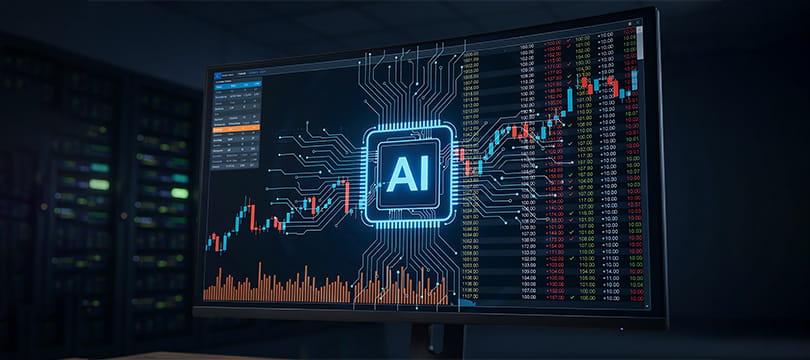
There is a lot of talk about it. Some consider it the real artificial intelligence, the only kind that is actually useful. Others see a hazard. What is certain is that agentic AI exists, that it is being marketed to many industries, and that trading is an obvious target for it. This article looks at what the term means, what an agent could actually do with a trading account, where the technology breaks, and what "working" would have to mean for the answer to be yes.
What Agentic AI Means, Applied to Trading
Agentic AI is a step beyond the use of artificial intelligence as an analysis tool. An AI agent does not merely answer a question or produce a forecast. It can take a goal, break it into tasks, gather information on its own, make decisions and interact with other systems with limited human involvement. Anthropic, one of the developers of the large language models (LLMs) that agents are built on, draws the line in a December 2024 engineering note called Building effective agents: workflows are "systems where LLMs and tools are orchestrated through predefined code paths", while agents are "systems where LLMs dynamically direct their own processes and tool usage, maintaining control over how they accomplish tasks". The difference is who decides the next step.
Applied to trading, that capability could in theory cover several stages. An agent could read macroeconomic data, company filings, press releases, news and price histories; compare them against a set of rules; form a decision; and send an order to the platform in use. None of this is foreign to finance. Algorithmic trading and quantitative systems have existed for years: strategies built on mathematical and statistical models that execute automatically on preset parameters. How generative models already fit into that picture, as research assistants rather than decision makers, is the subject of generative AI and how to use it for trading.
The difference lies in the degree of autonomy. A traditional algorithm follows rules defined in advance. An agent may choose which information to look for, how to interpret it and which actions to take to reach the goal it was given. That is the promise and, as the rest of this article argues, the problem.
Why It Could Work
Some features make agentic AI in trading genuinely interesting. The first is the volume of information it can process. A human cannot read thousands of documents, quarterly results, management statements and news items from dozens of sources at the same time. A system can. It is no surprise that AI is already used in large markets to produce signals, analyze corporate documents and interpret financial news as it arrives, and that its adoption at investment banks, asset managers and hedge funds keeps growing. In a survey published by the Bank of England and the Financial Conduct Authority on 21 November 2024, 75% of the UK financial firms that responded said they were already using AI and another 10% planned to within three years, against 58% and 14% in the 2022 edition of the same survey. That covers AI used for any purpose, though: the uses reported most often were the optimization of internal processes (41% of respondents), cybersecurity (37%) and fraud detection (33%).
The agent also has a theoretical advantage over the human trader: it feels no fear and no excitement. It can keep applying quantitative criteria while the market is going through one of its turbulent stretches, which is exactly when a person tends to stop applying them.
And this is where a misunderstanding begins. Not feeling emotions does not mean being infallible. An agent can work from incomplete data, give too much weight to irrelevant information, or simply misread what it has collected. The absence of panic is not the presence of judgment.
Where It Breaks
Generative models have a known failure mode, usually called hallucination: they can produce false information and present it as reliable. In a system whose only job is to summarize a document, the user can catch the error. If the same error feeds automatically into a decision to buy or sell, the consequences can be severe before anyone looks. Hallucinations, the opacity of the models and the difficulty of reconstructing why an autonomous decision was taken make the picture harder, not easier. The same regulators' survey is sobering on opacity: 46% of the firms surveyed said they had only a partial understanding of the AI technologies they use, against 34% claiming a complete one, mostly because the models come from third parties.
Then there is the oldest problem in automated trading: a model that worked on historical data is not necessarily going to work in the future. Markets change, correlations shift, and an unforeseen event can make a strategy that held for years suddenly inadequate. An agent that can rewrite its own approach adds a second version of the same problem, because it can also overfit on the fly, tuning itself to the recent past with no one checking. The mechanics of that trap are covered in the article on code overfitting in AI-driven trading systems, and the discipline that keeps a test honest in AI-powered backtesting.
Autonomy also multiplies the cost of an error. A human who misreads a number makes one bad trade. An agent that misreads a number can make the same bad trade on twenty markets before the next review, or react in an unplanned way to a situation that was not in its instructions.
The Collective Problem
If many participants ran similar systems, a problem of a different kind would appear. Agents trained on similar information and similar logic could take decisions in the same direction at the same time. In its report on the financial stability implications of artificial intelligence, published on 14 November 2024, the Financial Stability Board lists market correlations among the vulnerabilities: "The widespread use of common AI models and data sources could lead to increased correlations in trading, lending, and pricing." Two of the possible causes it names are herding, with firms imitating one another's choices of data and models, and the limited choice of models that a concentration of providers can produce. The International Monetary Fund's Global Financial Stability Report of October 2024 spells out the consequence in its chapter on AI and capital markets: one of the new risks that may arise is "increased market speed and volatility under stress, especially if trading strategies of AI models all respond to a shock in a similar manner or shut down in response to an unforeseen event". Among the policy responses it suggests is the calibration of circuit breakers "in light of potentially rapid AI-driven price moves".
In normal conditions, automation can add liquidity and efficiency. In stress, speed can amplify moves. Correlated strategies that produce synchronized behavior do not need to be wrong to be dangerous; they only need to be the same. The composure presented earlier as an advantage has another side: a model that never panics can still respond to a shock, or shut down, in step with every model like it.
So, Can Agentic AI in Trading Work?
The question cannot be answered with a plain yes or no, because much depends on what "work" means.
If the goal is a system that collects data, watches for stated conditions, analyzes large amounts of information and executes within preset limits, the technology already has useful properties. That is an extension of what algorithmic trading has done for a long time, with a more flexible reader of unstructured information bolted on.
It is much harder to argue that a fully autonomous agent can find profitable trades systematically and beat the market over time. More processing power does not remove the uncertainty that defines financial markets. The agent reads faster; it does not know the future any better than the data allows, and the data allows very little at short horizons.
So the decisive element may not be the ability to remove the human, but the quality of the constraints imposed on the machine: limits on what it can trade and how much, risk controls that sit outside the model, verification of the data it consumes, a log of every decision, and a way to stop the system immediately. The same Anthropic note recommends "finding the simplest solution possible, and only increasing complexity when needed", describes agents that "pause for human feedback at checkpoints", and advises "extensive testing in sandboxed environments, along with the appropriate guardrails". That is advice from a model developer to the people building agents, and it reads like a risk manager's checklist.
This site runs one small version of that division of labor. Every trading evening an AI model writes a plan for the next session for each market it reads as directional, with an entry, a stop and two targets; each plan is published before the session and verified afterward on real candles, win or lose, on the AI Daily Forecast page. The model proposes. The execution, if any, belongs to a person, and the trade panel that carries those plans into MetaTrader 5 never opens a position by itself; the reasons for that design are in expert advisor vs trade panel. That is not a claim that the arrangement is profitable; the record decides that, and it is published precisely so that it can. It is a claim about where the autonomy stops.
Agentic AI can become an important tool in trading, but autonomy and reliability are not synonyms. The real change may consist not in handing the market to agents, but in deciding with precision which tasks they can perform alone and which must keep a human in the loop.