
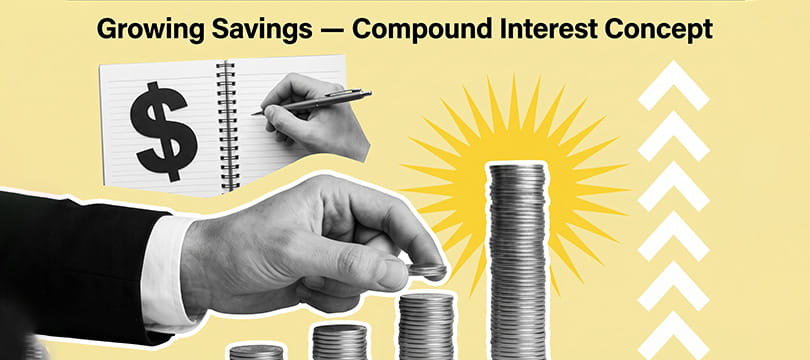
Compound interest is arithmetic. It is described so often as magic that people stop looking at the equation, which is a shame, because the equation is where the useful part lives, including the half that works against you.
The quote is not Einstein's
Start with the intellectual honesty, because the misattribution is itself instructive.
The line about compound interest being the eighth wonder of the world, with the coda that those who understand it earn it and those who do not pay it, appears in an enormous number of finance books, seminars and social media posts, always credited to Albert Einstein.
There is no evidence he ever said or wrote it. Quotation researchers have traced it back through decades of repetition without finding an original source, and the earliest known appearance is an unattributed 1925 advertisement for a savings and loan company, thirty years before Einstein's death. The attribution to him shows up in print only from 1983.
The mathematics is not improved by the attribution and not damaged by its absence. But a financial claim that survives on the strength of a name rather than a source is worth noticing, because a great deal of investing advice works the same way.
What compounding actually is
Compound interest means that interest earned is added to the principal and then earns interest itself. You are paid on what you invested and on what you have already been paid.
The contrast with simple interest makes the difference visible.
Invest $10,000 at 10% for thirty years.
Simple interest pays $1,000 a year on the original sum: $30,000 of interest, $40,000 total.
Compound interest pays 10% on the growing balance: about $174,000 total.
Same principal, same rate, same period. The difference is $134,000, and it comes entirely from interest earning interest.
The formula, and why the exponent is everything
The final amount is:
M = C × (1 + r)n
where C is the starting capital, r is the rate per period as a decimal, and n is the number of periods.
The important feature is that n is an exponent, not a multiplier. Doubling the rate multiplies the outcome several times over: $10,000 for thirty years is $43,000 at 5% and $174,000 at 10%. Doubling the time does more still: sixty years at 10% is $3.04 million.
A useful shortcut is the rule of 72: divide 72 by the annual percentage return to get the approximate number of years to double your money. At 6%, twelve years. At 9%, eight years. At 12%, six years. It is an approximation, accurate enough for mental arithmetic.
Time beats size, and it is not close
The exponent is why starting early matters more than starting big, and the standard illustration is worth working through.
Two people, both earning 8% a year.
The first invests $2,000 a year from age 25 to 35, then stops and never adds another cent. Total contributed: $20,000, over ten years.
The second starts at 35 and invests $2,000 a year until 65. Total contributed: $60,000, over thirty years.
At 65, the first person, who contributed a third as much and stopped three decades earlier, has more money.
The ten years the first investor gained at the start are worth more than the twenty extra years of contributions the second made, because those early dollars had thirty to forty years to compound, while the second's averaged fifteen. In compounding, the first decade is doing work the last decade cannot replicate at any contribution level.
How it works in a portfolio
Compounding operates in three ways in real investments, and only one of them is automatic.
Reinvested income. Dividends and coupons that are reinvested buy more shares or bonds, which produce more income. Over long periods, reinvested dividends account for a very large share of the total return of equity indices; the difference between price return and total return is not a footnote.
Retained earnings. A company that keeps profits and reinvests them productively compounds internally. The shareholder does nothing, and the value of the business grows on itself.
Not withdrawing. The most underrated mechanism. Compounding requires the base to stay in place. Money taken out stops working, and so does everything it would have earned. When withdrawals cannot be avoided, their timing decides how much damage they do; the article on sequence of returns risk shows why the same returns in a different order leave a very different balance.
The other direction
The second half of the line, that those who do not understand it pay it, is the more urgent half.
Compounding does not care which way it points. Credit card debt at 20% compounds against you exactly as reliably as an investment at 20% would compound for you, and considerably faster than any realistic investment return.
Minimum payments are the mechanism. They are calculated to cover interest plus a small fraction of principal, so a balance can survive for years while being paid every month. The compounding is doing the work and the payment is barely keeping ahead of it.
The arithmetic consequence is straightforward: paying off high-interest debt is mathematically superior to investing, because the guaranteed return equals the interest rate avoided, and no investment offers a guaranteed 20%. The obvious exceptions are employer-matched and tax-advantaged contributions, where the match or the tax relief is an immediate return larger than most interest rates.
What compounding does to a trading account
This is where the concept stops being personal finance and becomes directly relevant to anyone trading, and where most of the damage is done.
Drawdowns compound against you asymmetrically. This is the single most important consequence and it is routinely misunderstood.
- Lose 10%, and you need 11% to get back to even.
- Lose 25%, and you need 33%.
- Lose 50%, and you need 100%.
- Lose 75%, and you need 300%.
- Lose 90%, and you need 900%.
Percentage losses and percentage gains are not symmetric, because the loss reduces the base that the recovery has to work from. This is the arithmetic argument for risk management, and it is stronger than any psychological one: capital preservation is not caution; it is the condition for compounding to happen at all.
Volatility drag. A sequence of returns compounds to less than its arithmetic average. Gain 50% then lose 50% and you are down 25% rather than flat. The more volatile the path, the wider the gap between the average return and what you actually end up with, which is why a steady 8% can beat a volatile 10% arithmetic average over a long period. The approximation is worth memorizing: the compounded return is close to the arithmetic average minus half the variance, so a 10% average with 20% volatility compounds at about 8%.
Costs compound too. A 1% annual fee does not cost 1%. Over thirty years at 8%, it removes roughly a quarter of the final value, because every dollar paid in fees is a dollar that never compounds. Spreads, commissions and financing charges work the same way in a trading account: a 1-pip spread on trades that average 20 pips is 5% of every move, paid on each round turn, and at a couple of hundred trades a year that is the same kind of number as a fund's fee, compounding against the balance in the same way.
The realistic version
Compounding illustrations tend to use 10% because it makes attractive charts. Three corrections make them honest.
Inflation. A nominal 8% with 3% inflation is a real 5%, and real is what buys things. Compounding a nominal figure over decades produces a number that looks impressive and describes purchasing power poorly.
Returns are not smooth. No investment delivers exactly its average every year. The sequence matters, particularly for anyone withdrawing: a bad run early in retirement does permanent damage that the same run late in retirement does not.
Tax. Where gains are taxed as they are realized, the tax paid each year stops compounding. Deferring realization is worth a meaningful amount over long horizons, which is one of the few genuinely free returns available.
What follows from the arithmetic
Start early. The exponent rewards time more than contributions, and no later effort recovers a lost decade.
Stay invested. Compounding requires continuity. Withdrawing, or sitting out to time the market, breaks the sequence in the way that costs the most.
Reinvest income. This is where a large part of long-run equity return comes from, and it asks only that you not spend it. The same discipline applies to a raise: lifestyle inflation is what happens when higher income is spent as it arrives, and the article on it shows what keeping half of a raise adds up to over a decade before any return, which is the base the arithmetic above then works on.
Clear expensive debt first. The guaranteed return of avoided interest beats an uncertain market return.
Protect the base. A drawdown is not merely a loss; it is a permanent reduction in what everything afterward compounds from. This is why the psychology of holding losers is expensive twice over.
Watch what costs. Fees, spreads and taxes compound against you with the same reliability that returns compound for you.
Arithmetic, not magic
Compounding is genuinely powerful, and it works precisely as the formula says. What makes it feel like magic is that human intuition is linear and the process is exponential, so the results after two decades look implausible to anyone reasoning from the first two years.
It also does nothing dramatic quickly, so it is easy to describe and hard to use. The mechanism requires time, continuity and a base that never gets destroyed, and it is the third that people get wrong, not through ignorance of the formula, but by taking a loss large enough that the exponent has to start again from a smaller number.