
Yes, with limits the firm spells out. FTMO permits discretionary trading, algorithmic trading and Expert Advisors as long as the trading is "legitimate (in line with proper risk management), conforms to the real market conditions" and would be "replicable on live accounts": that is the wording of its own FAQ, read on 8 September 2026. Around that permission sits a page of forbidden practices, a technical cap on hyperactive robots, and the trading objectives that decide whether the account survives the day. This article reads those rules line by line, then asks the question most guides skip: what changes when the prop firm EA on the chart is not a robot at all, but a trade panel that only acts on your click.
It is the prop-firm chapter of the full MT5 trade panel guide. FTMO is used as the reference firm because its rules are public and detailed. Every rule below is quoted from an FTMO page with the date it was read. Rules change: check the current rulebook before acting on any line below, because the rulebook, not this article, is what counts.
What FTMO Allows: The Rule in Its Own Words
The FAQ entry "Which instruments can I trade and what strategies am I allowed to use?" (read 8 September 2026) is the permission. You can trade "all the instruments and assets that are available in your trading platform (Forex, Indices, Commodities, Stocks, Crypto,…)", and the strategy can be discretionary, algorithmic or run by an Expert Advisor, provided the trading remains "legitimate (in line with proper risk management), conforms to the real market conditions" and is "replicable on live accounts to generate the same results as on your FTMO Account".
Three details in the same answer matter more than the headline:
- Third-party EAs carry a warning. In the firm's words, "if you use an EA from a third party, there might be other traders already using the same EA and therefore exactly the same strategy", and "by using a third-party EA, you potentially run a risk of being denied the FTMO Account if you exceed the maximum capital allocation rule". It is not a ban; it is a caution that the firm watches for many accounts doing exactly the same thing.
- There is a hard technical cap: "200 orders at a time and 2000 max positions per day limitation". A hyperactive EA has to be adjusted to fit.
- Stop losses are not required. "We do not require you to use a Stop-loss (although it's generally advisable to always have certain safety measures in place)"; the objectives below explain why that advice is worth taking literally.
The companion entry "What is 'Trading according to a real market'?" adds the principle behind all of it: "Trading must be legitimate and traders must not use practices that contradict the functioning of a real market." For the list of what that means, the FAQ points to the forbidden-practices page and to clause 7.3 of the FTMO Challenge Terms and Conditions.
What FTMO Forbids: The Forbidden Trading Practices Page
The page "Forbidden Trading Practices" (read 8 September 2026) is short and specific. In its own words, a trader must not:
- "use trading strategies that exploit errors in our Services, such as errors in the display of prices or delays in their updates, or an external or slow data feed": the latency-arbitrage family;
- "perform, alone or in concert with other persons — including between connected accounts, accounts held with various operators/providers, or accounts held with other members of the Program Group — simulated trades or combinations of trades for manipulative purposes, for example by simultaneously entering into opposite positions (with the exception of entering into such positions on a single simulated account)": hedging across accounts, not within one;
- "perform simulated trades in conflict with the FTMO General Terms and Conditions or the FTMO Account Terms and Conditions (FTMO Account Agreement) (as applicable) or the terms and conditions of the trading platform you use";
- "use any software, artificial intelligence, ultra-high-speed tools, or mass data entry that might manipulate, abuse, or give you an unfair advantage";
- "perform gap trading" by opening trades "when major global news, macroeconomic events, or corporate reports or earnings are scheduled…" or "two hours or less before a relevant financial market is closed for at least two hours";
- "otherwise perform simulated trades that contradict how trading is actually performed in the financial markets, or in a way that we reasonably consider might cause us financial, reputational, or other harm as a result of your activities (e.g., overleveraging, overexposure, one-sided bets, account rolling)": the item a panel user should read twice, because overexposure and one-sided bets are exactly what an exposure warning exists for;
- run trades "operated or managed by automated robots / EAs (Expert Advisors) which cause the trading account to become hyperactive in the sense of an excessive number of more than 2,000 server requests per day";
- "use trading strategies that artificially distribute profit across multiple days without proportionally distributing market risk, such as hedging or holding opposing positions on the same or highly correlated instruments" to circumvent the Best Day Rule (explained under the objectives below).
Two personal-use lines close the page: "You must not allow any third party to access or otherwise use your FTMO Account or your FTMO Challenge/Verification account", and "You must not access, or perform simulated trades on, any other person's FTMO Account or FTMO Challenge/Verification account…". The consequences are listed too: "removal of simulated trades from your history, restricted access to a trading platform, disqualification from the Evaluation Process, forfeiture of any potential Rewards, or even termination of all agreements".
Read as a whole, the page is not about automation. Nothing on it forbids an EA because it is an EA. It forbids exploiting the simulated environment, acting in concert across accounts, gap-trading the news and the close, swamping the server, and trading in a way that "contradict[s] how trading is actually performed in the financial markets"; the page's own examples of that last one are "overleveraging, overexposure, one-sided bets, account rolling". An EA that does none of those things is inside the rules; a human who does any of them by hand is outside.
Where a Trade Panel Sits in Those Rules
A trade panel is technically an Expert Advisor (that is how MetaTrader 5 loads anything that draws on a chart and sends orders), but it does not trade by itself. In the ForexSentiment AI Trade Panel, every order starts from your click and, by default, passes through a confirmation dialog that restates the order; the only automatic rules are the opt-in protections you arm yourself, and they can only close or protect. Measured against the page above:
- Server requests. The panel downloads its data (signals, plans, retail positioning) from forexsentiment.live on a timer you set, between 60 and 3,600 seconds; that traffic goes to the website, not to the broker's trade server. Trade server requests happen when you place, modify or close something, and when a protection rule fires. A discretionary trader placing a handful of orders a day is nowhere near 2,000.
- Unfair advantage. Nothing in the panel reads the market faster than the terminal does; it fills in lot, stop and target from the plan and your risk setting. The speed is the human's.
- Gap trading. The panel does not know FTMO's news list. If the plan's limit order would fill in a window the firm forbids, that is on the trader, not the tool; the section on news below is the practical answer.
- Identical trades. This is the honest caveat. The daily plans the panel shows are published to everyone, so two FTMO traders who both take the USD/JPY plan at the published entry will show similar orders. FTMO's own text treats that scenario as a warning about third-party EAs used by many accounts, not as a listed forbidden practice, and the plan is public analysis rather than a strategy running unattended. Which plans you take, at what size and with what stop remains your decision every time, and if the rulebook changes on this point, the rulebook wins.
The Daily Loss Limit, and How Close-Only Rules Help You Stay Inside It
The page "Trading Objectives" (read 8 September 2026) sets the lines. The Maximum Daily Loss "establishes a limit (the Maximum Daily Loss Limit) below which your account equity cannot drop", computed as the difference between the account balance recorded at 00:00 CE(S)T and a fixed share of the Initial Simulated Capital: 3% on the 1-Step evaluation, 5% on the 2-Step. It is measured on equity, which includes the floating profit and loss of open positions, so an open loser can breach the line before anything is closed. The Maximum Loss is 10% of the initial capital: static on the 2-Step, an end-of-day trailing limit on the 1-Step. Profit targets are 10% (1-Step) and 10% then 5% (2-Step), with at least four trading days on the 2-Step. The 1-Step adds the Best Day Rule: your best day must not "represent more than 50% of your Positive Days' Profit", so one outsized day has to be balanced by further profitable days before the target counts. Exceeding the limit "is not treated as a rule breach", the page says; the account simply has to keep trading. The 1-Step has no minimum-trading-days rule.
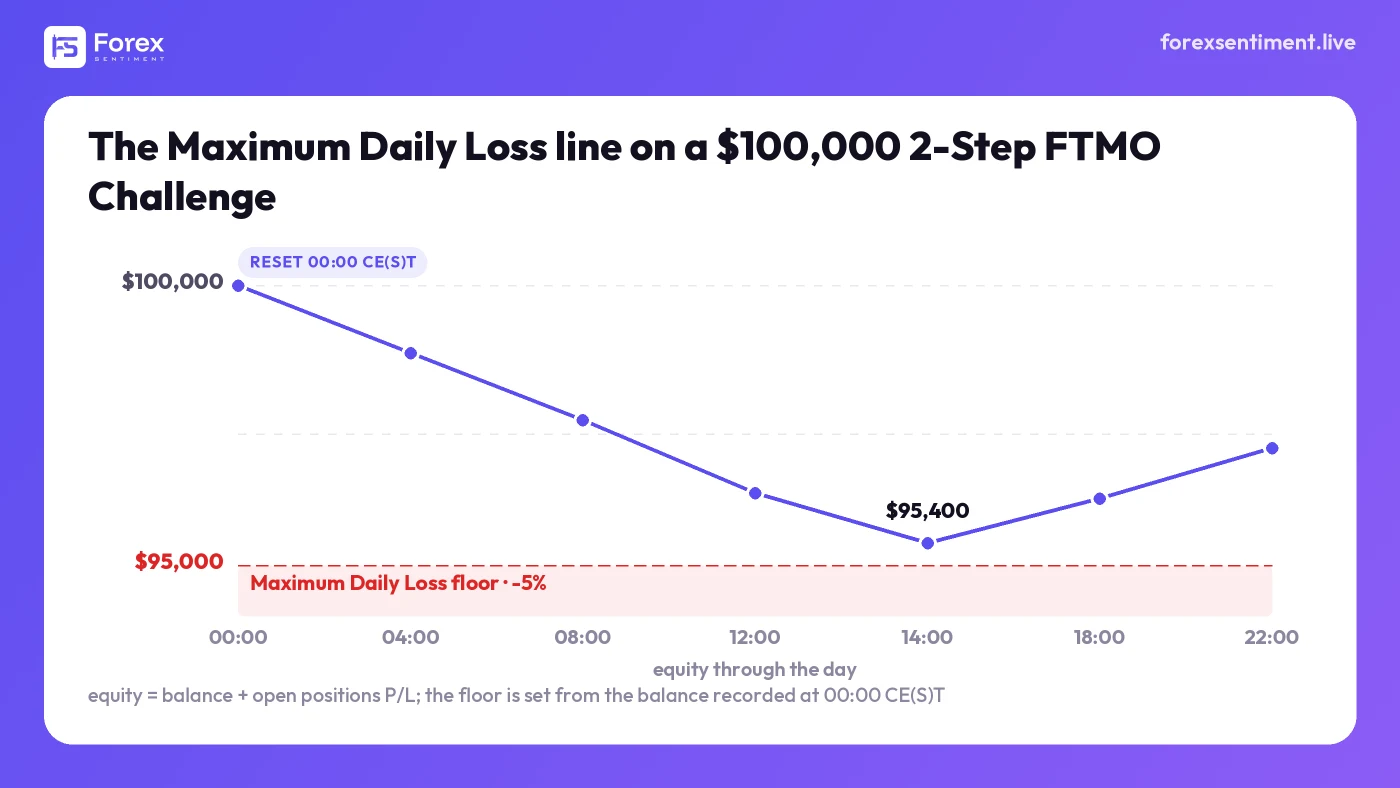
Example on a $100,000 2-Step FTMO Challenge: the daily floor is $95,000 (the balance at 00:00 CE(S)T minus 5% of the initial capital) and it counts floating P/L, so an open loser can breach it before anything is closed.
On a $100,000 2-Step account the day-one floor is $95,000. In the illustration the equity dips to $95,400 at 14:00, $400 above the floor, and recovers. That number is what the panel's five close-only rules are for:
- Max floating loss closes everything on the account (or only the panel's trades, if you narrow the scope) at a loss ceiling you set. Set it inside the firm's line, say a few hundred dollars above the floor, and the account is flat before the objective is breached, instead of one candle after.
- Max floating profit closes everything at the profit level you set: a way to bank a good day rather than give it back.
- Profit trail arms once the open profit of the covered positions reaches a level you set and closes them if it falls back from its peak by the distance you set; it works on the account's floating result, not on any single stop.
- Plan autopilot moves the stop to entry on plan trades as soon as the conservative target is touched; there is also a one-click breakeven, per position or for all of them at once, for the trader who decides by hand.
- Close before rollover flattens the book before the daily boundary and the weekend. One caution: the panel closes a few minutes before the broker's daily boundary (or the session close, when that comes first), while FTMO resets the daily loss at 00:00 CE(S)T; the two may not coincide on every server.
And one thing that is not a rule but a warning: before the click, the confirmation dialog says when a new order stacks exposure you already hold, a correlated pair or a second position pushing the same currency the same way. It is the panel's answer to "overexposure, one-sided bets" on the forbidden-practices page, and it warns; it does not block.
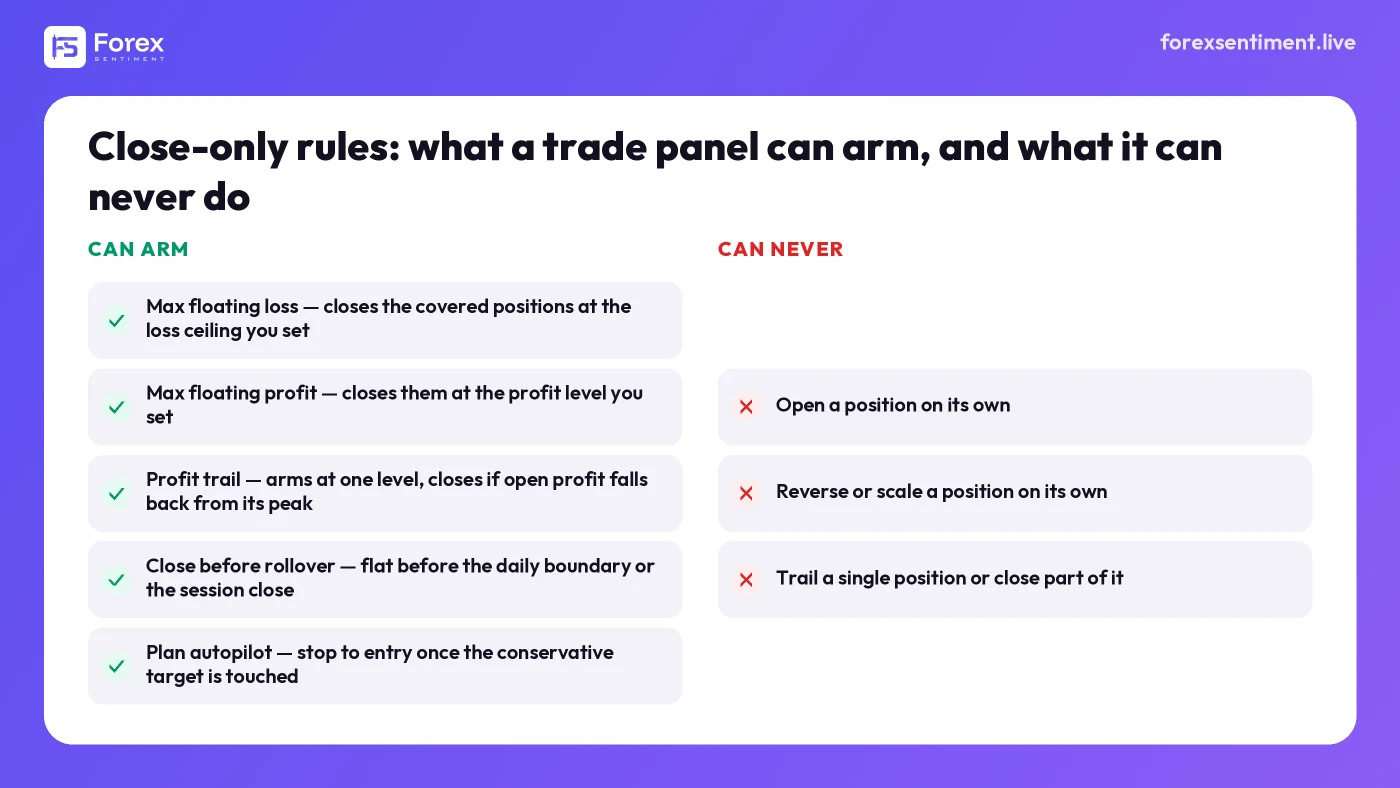
Five close-only rules the ForexSentiment AI Trade Panel can arm, the loss and profit ceilings, the account-level profit trail, close before rollover and the plan autopilot's stop-to-entry, and what it can never do: open, reverse or scale a position on its own, trail a single position or close part of it. The exposure warning is separate: it appears in the confirmation dialog before the click.
None of this makes an account "compliant"; the firm decides that, on its current rules. What the rules do is turn the daily loss from a number you hope to remember into a line at which the software flattens the book, as long as the terminal is open.
News, Swing Accounts and the Two-Minute Window
The FAQ "Can I trade news?" (read 8 September 2026) draws a line that a panel user must know. On funded FTMO Accounts of the Standard type "it is not permitted to open or close any trades, including the execution of pending orders (such as Stop Loss or Take Profit), within a time window starting 2 minutes before and ending 2 minutes after the release of selected news announcements"; the Swing account type has no such restriction, and during the Evaluation Process news can be traded freely. A stop loss that fires inside the window counts as a breach on a Standard account.
The plans the panel places are limit orders that last for a fixed window and fill whenever price reaches the published entry, including, potentially, 90 seconds before a payroll release. The panel does not enforce FTMO's list. The practical habit is to read the day's economic calendar before arming anything on a funded Standard account, and to keep pending orders and stops out of the two-minute windows around the releases the firm names.
VPS, Consistency and the Rest
Two smaller rules, from the FAQ entries "Can I travel or use VPN/VPS?" and "Do you have any consistency rules?", both read on 8 September 2026. VPN and VPS are "generally allowed", with a United States caveat: clients "should also avoid changing their geolocation to the United States when using MetaTrader, cTrader or TradingView", and traders who travel there "should avoid logging in to MetaTrader and cTrader accounts from there". On consistency, "Your trading consistency is primarily evaluated based on the Trading Objectives", and "Provided you maintain sustainable risk management practices, there are no additional consistency requirements for your trading".
The Five Ways Traders Get Eliminated Anyway
Rules are rarely what ends an evaluation; risk is. The most common exits are oversizing the first days, adding to a loser, trading the news window, ignoring the daily line while a position is open, and treating the target as a deadline. The habits behind them (ignoring the risk rules, trading on emotion, forcing the timeline, arriving without a tested strategy, buying reset after reset) are the subject of Passing a Prop Firm Challenge: 5 Mistakes That Get Traders Eliminated, and the pass-rate data is in this blog's article on prop-firm challenge pass rates. A panel helps with the mechanical half of that list (sizing, stops, the daily ceiling) and does nothing about the other half.
Checklist Before You Attach a Panel to a Challenge Account
- Check the current rulebook: the trading objectives, the forbidden-practices page and the FAQ on strategies. Note the date you read them.
- Confirm the tool never opens a position on its own and that every order passes through a click; keep the confirmation dialog on.
- Set the max floating loss inside the firm's daily line, on equity, with margin for spread and slippage.
- Size from risk per trade, not from a fixed lot, so the daily line is a number of trades away, not one.
- On a funded Standard account, check the day's calendar and keep pending orders and stops out of the two-minute news windows.
- Do not run the same account from two terminals, and do not share access.
- Check the terminal's daily boundary against 00:00 CE(S)T before trusting "close before rollover" to protect the daily reset.
- If the plan you take is public, size and choose it as your own decision: that is what "legitimate" means in the rule.
Related Reading
- The panel's user guide: the Manage tab and every protection rule, step by step.
- FTMO: the firm whose rules are quoted here.
How This Article Was Made
Every rule is quoted from FTMO's public pages ("Which instruments can I trade and what strategies am I allowed to use?", "What is 'Trading according to a real market'?", "Forbidden Trading Practices", "Trading Objectives", "Can I trade news?", "Can I travel or use VPN/VPS?" and "Do you have any consistency rules?"), all read on 8 September 2026. Panel behavior is taken from the ForexSentiment panel's public manual and its settings screen. The rules are the firm's to set and to change. Trading carries a substantial risk of loss and is not suitable for every investor.